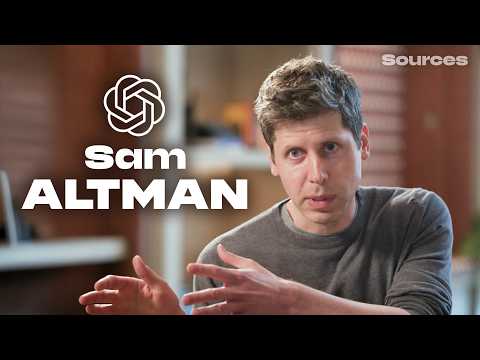
Sam Altman on AI Inertia, Pre-iPhone Interfaces & Outlier Founders

Sam Altman
Co-Founder & CEO, OpenAI · Former President of Y Combinator
The driving force behind ChatGPT, GPT-4, and the modern generative AI era. In this in-depth fireside with David Senra, Altman reflects on the friction of economic inertia, why AI disruption is taking longer than expected, and the non-consensus bets required to build transformative companies.
⚡ Executive Summary
- On Slower-Than-Expected AI Disruption: Admitted that post-GPT-4 expectations of rapid, overnight software market replacement were “too ambitious”, as the real-world economy and human habits possess immense inertia.
- On the Pre-iPhone Era of AI: Argued that while all foundational technological pieces exist today, the industry still lacks the transformative product interface that fundamentally changes human-computer interaction.
- On Toby Lütke & Enterprise Agent Adoption: Highlighted Shopify’s CEO as the premier forward-leaning leader who writes code himself and rejected being an “NPC company” by aggressively deploying autonomous AI agents.
- On Non-Consensus Conviction: Emphasized that generational founders are defined by holding deeply unpopular convictions that turn out radically right, rather than pursuing marginal variations of consensus ideas.
- On the Micro-Business Explosion: Predicted an unprecedented boom in solo and small businesses powered by AI, lowering the barrier to entry for founders outside traditional venture hubs.
- On the #1 Success Metric: Pointed to relentless velocity, fast shipping, and rapid iteration loops as the single highest-correlating trait of outlier startup success from years of YC data.
📌 Timestamped Insight Cards
⚡ 1. Economic Inertia: Why AI Adoption is Slower Than Expected [▶ @ 04:16]
“The economy just has so much inertia. People keep doing the same things they’re doing. They keep buying from the same company. They keep sort of wanting to use their tools in the same way… and it’s going to make this big transition in front of us go smoother and slower. I’m grateful for it, but I think it means we’ve all been too ambitious on timelines.”
Deep Insight: Altman candidly admits his initial timeline after launching GPT-4 was overly aggressive. Despite exponential model progress, real-world commerce and enterprise workflows move with heavy friction. He views this slower pace not as a setback, but as a crucial stabilization buffer that grants society, workers, and regulatory institutions necessary breathing room to adapt.
📱 2. The Pre-iPhone Era of AI: Missing the Ultimate Interface [▶ @ 08:29]
“And a lot of the technology was there. Like it was missing multi-touch, but mostly it was missing like the product ideas that made the iPhone the iPhone. And I feel like we are now in a world where we have all of the technological pieces, but we have not had the iPhone moment of like completely changing how someone interfaces with technology.”
Deep Insight: Comparing the current state of AI to smartphones in 2003 (like the Palm Treo), Altman highlights that having raw intelligence is insufficient. The industry is still searching for its defining multi-touch breakthrough—the native UX paradigm that makes agentic computing intuitive rather than requiring users to manually toggle between legacy clicks and prompt windows.
💡 3. Non-Consensus Conviction: Spotting True Outlier Founders [▶ @ 14:04]
“It’s very clear to me when you have someone who just thinks differently than most other people and is willing to stand by convictions that are very unpopular, may well be wrong, but if right, at least they’re going to be really right versus someone who is a thin veneer on the same idea that everybody else has.”
Deep Insight: Drawing on his years leading Y Combinator and founding OpenAI in 2015 when AGI was widely mocked, Altman explains the arithmetic of power laws. Breakthrough ventures cannot come from consensus-driven safe bets. The best founders embrace contrarian risk where the probability of failure is real, but the upside fundamentally reshapes an entire industry.
🤖 4. Forward-Leaning Leadership: Shopify & Rejecting ‘NPC Companies’ [▶ @ 00:17]
“He has been the most forward-leaning CEO. He’s in there like writing the software himself. He is experimenting with it. He sends us extremely detailed feedback on the product offering, on the capabilities of the models. He was before anybody else was saying this, he was like, ‘We are not an NPC company and thus we are going to adopt agents… We’re going to build it ourselves.’”
Deep Insight: Altman singles out Shopify CEO Toby Lütke as the gold standard for executive adaptation in the AI era. Instead of delegating AI strategy to layers of middle management, visionary leaders get their hands dirty in code, directly stress-testing agentic workflows to ensure their organization does not become a passive, vulnerable “NPC” in an automated economy.
🚀 5. Democratizing Enterprise: The Boom of AI-Powered Micro-Founders [▶ @ 43:51]
“And we are about to see the greatest boom in people starting smaller businesses that we have ever seen. I think AI is empowering that. Now, for some reason the field, including us, has not talked about that enough even though we see all these signs of it… but I think we’re going to see a lot more of that.”
Deep Insight: Beyond mega-cap AI infrastructure, Altman forecasts that the most profound economic transformation will occur at the long tail. By automating design, development, marketing, and customer support, AI radically lowers capital requirements, enabling a massive global explosion of highly profitable, small-scale enterprises run by lean teams or solo operators.
⚡ 6. The Core Law of Startups: Speed of Iteration & Rapid Shipping [▶ @ 01:00:27]
“I’m astonished looking back at all of my data points of YC founders over the years how much the ability, the like moving fast and being iterative correlates with success.”
Deep Insight: Analyzing decades of venture data, Altman reaffirms that raw intelligence or polished business plans are secondary to momentum. Outlier founders treat shipping not as a grand milestone, but as a continuous feedback loop—launching quickly, absorbing market signal, and compounding improvements faster than competitors can deliberate.