Jeff Dean Interview Breakdown: Key Insights on MoE, TensorFlow & Discovery Loop
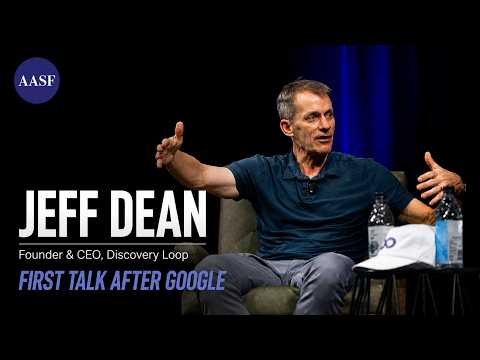
Jeff Dean
Co-Founder & CEO, Discovery Loop · Former Chief Scientist, Google
One of the foundational architects of modern computing and AI. Over 27 years at Google, Dean co-created MapReduce, BigTable, TensorFlow, Google Brain, and Gemini. In this historic talk, he reflects on architectural lessons, MoE scaling, and his new venture, Discovery Loop.
⚡ Executive Summary
- On Mixture of Experts (MoE): Emphasized that the foundational insight behind sparse models was decoupling parameter memory capacity from compute cost, activating only necessary sub-networks per token.
- On TensorFlow’s Design Regrets: Identified the initial lack of eager execution (later popularized by PyTorch/JAX) and the community
contribsubdirectory as key architectural mistakes that led to API fragmentation. - On Research Strategy & Conceptual Point Clouds: Urged students to skim 100 paper abstracts rather than deep-diving into a single paper to build high-dimensional mental maps of what is technically possible.
- On AI in Cybersecurity: Framed autonomous agent capabilities as an accelerated dual-use arms race, supercharging both offensive vulnerability exploitation and automated defensive patching.
- On Neural Architecture Search (NAS): Highlighted the power of reinforcement learning loops where AI models generate and evaluate neural topologies, outpacing human manual heuristics.
- On Leaving Google & Founding Discovery Loop: Explained that while Google maintains immense infrastructure, accelerating scientific discovery requires the focused agility of an independent, mission-driven startup.
📌 Timestamped Insight Cards
⚡ 1. Sparsely-Gated MoE: Massive Capacity Without Quadratic Compute [▶ @ 06:56]
“The intuition behind the work was really that you want to have really, really large models that have a lot of capacity to remember lots of things, but you don’t want to activate all the parameters for every single token or every single input because that’s computationally too expensive.”
Deep Insight: Long before modern Mixture-of-Experts (MoE) architectures became the standard for frontier LLMs (GPT-4, Gemini 1.5, Mixtral), Jeff Dean pioneered sparsely-gated computation. His fundamental design principle was decoupling parameter capacity from per-token compute cost—enabling trillion-parameter models that activate only a selective fraction of experts per inference step.
🛠️ 2. TensorFlow Retrospective: The Eager Execution & ‘Contrib’ Directory Traps [▶ @ 14:47]
“Things we did wrong I think… well first we didn’t have kind of this eager execution mode that has been popular in frameworks like PyTorch and JAX… And then the other thing we did wrong was in the open source release, we created a subdirectory called contrib and we allowed lots and lots of different external people to contribute all kinds of different helper libraries… and I think that just confused the community a lot.”
Deep Insight: Dean candidly dissects TensorFlow’s two critical historical architectural flaws: relying too long on static declarative graphs without native eager execution, and introducing the contrib folder. By allowing fragmented, redundant community extensions into the main repo, TensorFlow created cognitive friction and API bloat, a foundational lesson for today’s agentic framework and model compiler developers.
📚 3. Research Strategy: Skim 100 Abstracts to Build Conceptual Clouds [▶ @ 22:18]
“I often tell students it’s better to skim 10 papers than to read one in detail because you kind of then get 10 points in your cloud of like what might be possible. Uh or even skim a 100 abstracts because what you want to be able to do is connect important ideas that have not yet been connected.”
Deep Insight: Dean challenges traditional academic dogma regarding microscopic paper deep-dives. By rapidly scanning hundreds of abstracts, researchers construct high-dimensional conceptual “point clouds” of emerging capabilities. When confronting complex engineering bottlenecks, this broad topological awareness allows them to synthesize seemingly disjoint sub-solutions into coherent end-to-end architectures.
🛡️ 4. AI & Cybersecurity: Supercharged Tooling on Offensive and Defensive Fronts [▶ @ 30:43]
“They can also be used to find security vulnerabilities, and that’s a double-edged sword. You could use them to patch security vulnerabilities that exist… and you could also as if you’re a malicious user you could use them to exploit them… they just now have much more sophisticated tools on both sides.”
Deep Insight: As autonomous AI agents gain multi-day vulnerability exploitation capabilities, Dean frames AI safety not as a one-sided risk, but as an accelerated arms race. While LLMs empower automated exploit chaining, they simultaneously provide defenders with unprecedented static analysis and semantic patching speed, shifting cybersecurity towards rapid, automated self-healing infrastructure.
🧠 5. Neural Architecture Search (NAS): AI Discovering Neural Topologies via RL [▶ @ 34:56]
“You can have a model generating model that generates machine learning model architectures and then evaluates how well those model architectures work on a variety of metrics… and then through an iterative reinforcement learning based process, the model generating model can get feedback on which kinds of decisions in the model architecture made sense.”
Deep Insight: Reflecting on early AutoML and evolutionary Transformer breakthroughs, Dean explains how automated reinforcement learning loops can systematically outperform human intuition in neural topology design. This meta-learning paradigm serves as the direct conceptual precursor to Discovery Loop’s core mission: closing the loop between hypothesis generation and empirical evaluation.
🚀 6. Leaving Google After 27 Years: The Agility of Mission-Driven Discovery Loop [▶ @ 43:18]
“First I have incredible fondness for my time at at Google. Uh you know I’ve been there 27 years. Amazing colleagues… But sometimes a focused small company with everyone focused on exactly that mission—and I think it’s a great mission—is going to be amazing.”
Deep Insight: After 27 years architecting Google’s foundational systems (MapReduce, BigTable, Google Brain, Gemini), Dean explains his transition to founding Discovery Loop. While hyper-scale tech giants excel at broad infrastructure, accelerating scientific discovery requires a hyper-focused, agile organization dedicated entirely to closing the loop between AI hypothesis generation and real-world scientific breakthroughs.