Andrej Karpathy Interview Breakdown: Key Insights on Autonomous Agents, RL & AGI
Andrej Karpathy
Founder, Eureka Labs · Former Director of AI at Tesla & OpenAI Founding Team
One of the world's most influential deep learning practitioners and educators. Having spearheaded Tesla Autopilot FSD and foundational research at OpenAI, Karpathy offers an unvarnished, engineering-grounded perspective on why autonomous agents will take a decade to mature and how AI will transform education.
⚡ Executive Summary
- The Decade of Agents: Transitioning from impressive prototypes to reliable digital employees capable of autonomous multi-step reasoning, persistent memory, and continuous learning will take a decade of systematic engineering, not a single hype cycle.
- Summoning Ethereal Ghosts vs. Biological Animals: LLMs are disembodied statistical artifacts mimicking human cultural text rather than embodied organisms shaped by physical survival and evolutionary pressures.
- Cognitive Deficits & Limits of Vibe Coding: While vibe coding succeeds on common web boilerplate, models suffer cognitive inertia and working-memory deficits when tasked with precision-critical, novel architectures.
- Why Reinforcement Learning is Inefficient: Applying coarse scalar rewards across long rollouts creates massive credit assignment noise—effectively “sucking supervision through a straw” without intermediate self-critique.
- Silent Mode Collapse in Synthetic Data: Autonomously training models on recursive synthetic thoughts triggers catastrophic distribution collapse because model generations occupy a narrow, low-entropy manifold of human ideas.
- The March of Nines from Tesla FSD: Moving from a 90% demo to a production-grade autonomous agent requires conquering exponential long-tail edge cases, where every additional “nine” of reliability demands constant, intense engineering.
- Eureka Labs & Elevating Human Agency: To prevent human cognitive atrophy and economic disempowerment in the AI era, Eureka Labs is pioneering adaptive 1-on-1 AI tutors to deliver high-bandwidth, Socratic technical education.
📌 Timestamped Insight Cards
⏳ 1. The Decade of Agents: Why Fully Autonomous AI Takes 10 Years, Not 1 [▶ @ 01:21]
“In my mind, this is more accurately described as the decade of agents… When you’re talking about an agent… you should think of it almost like an employee or an intern that you would hire to work with you… Why don’t you do it today? The reason you don’t do it today is because they just don’t work… They don’t have continual learning. You can’t just tell them something and they’ll remember it. They’re cognitively lacking and it’s just not working. It will take about a decade to work through all of those issues.”
Deep Insight: Karpathy deflates the narrative of an instantaneous agent revolution. Genuine digital agency requires the cognitive stability of human knowledge workers: lifelong memory retention, stateful tool execution, and near-zero hallucination rates under open-ended ambiguity. Achieving these production-grade capabilities across complex enterprise stacks is a multi-year slog of architectural refinement.
👻 2. Summoning Ethereal Ghosts, Not Building Biological Animals [▶ @ 09:20]
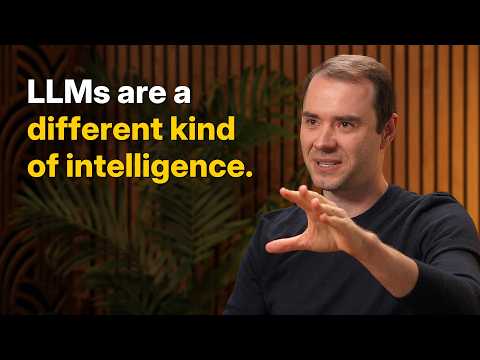
“In my post, I said we’re not building animals. We’re building ghosts or spirits or whatever people want to call it, because we’re not doing training by evolution. We’re doing training by imitation of humans and the data that they’ve put on the Internet. You end up with these ethereal spirit entities because they’re fully digital and they’re mimicking humans. It’s a different kind of intelligence. If you imagine a space of intelligences, we’re starting off at a different point almost.”
Deep Insight: Deep learning researchers often rely on flawed biological metaphors. Animals evolved via millions of years of physical embodiment, spatial navigation, and evolutionary survival loops. In contrast, transformer LLMs are ethereal statistical shadows generated purely through next-token text prediction over the internet. They possess vast encyclopedic knowledge without physical intuition, representing a fundamentally alien branch of intelligence.
🧩 3. The Limits of Vibe Coding: Cognitive Deficits in Precision Engineering [▶ @ 31:16]
“Then there’s the vibe coding: ‘Hi, please implement this or that,’ enter, and then let the model do it. That’s the agents. I do feel like the agents work in very specific settings… if you’re doing boilerplate stuff… that occurs very often on the Internet… But nanochat is not an example of those because it’s a fairly unique repository… The models have so many cognitive deficits… they kept misunderstanding the code because they have too much memory from all the typical ways of doing things on the Internet.”
Deep Insight: Unsupervised agentic coding thrives on standard CRUD applications and well-trodden boilerplate code because internet pre-training corpora contain millions of similar examples. However, when architecting novel, high-density algorithmic software (such as Karpathy’s NanoChat), LLMs exhibit cognitive bias, persistently reverting to conventional patterns and failing to maintain precise architectural constraints.
🥤 4. The Inefficiency of Reinforcement Learning: Sucking Supervision Through a Straw [▶ @ 43:19]
“The way I like to put it is you’re sucking supervision through a straw. You’ve done all this work that could be a minute of rollout, and you’re sucking the bits of supervision of the final reward signal through a straw and you’re broadcasting that across the entire trajectory and using that to upweight or downweight that trajectory. It’s just stupid and crazy. A human would never do this.”
Deep Insight: Modern RL algorithms face severe credit assignment degradation on multi-step reasoning tasks. Assigning a binary scalar reward at the end of a long token trajectory blindly reinforces every intermediate step—including incorrect dead-ends and lucky guesses. Unlike human cognition, which performs localized introspection and structural error analysis, standard policy gradients lack nuanced step-by-step credit attribution.
📉 5. Mode Collapse in Synthetic Data: Why Self-Play Hits Entropy Walls [▶ @ 52:12]
“Every synthetic example, if I just give synthetic generation of the model thinking about a book, you look at it and you’re like, ‘This looks great. Why can’t I train on it?’ You could try, but the model will get much worse if you continue trying. That’s because all of the samples you get from models are silently collapsed… They occupy a very tiny manifold of the possible space of thoughts… One easy way to see it is to go to ChatGPT and ask it, ‘Tell me a joke.’ It only has like three jokes.”
Deep Insight: Recursive training on model-generated synthetic data suffers from silent entropy decay. While individual synthetic reasoning samples appear coherent, the global output distribution rapidly collapses onto a narrow subset of linguistic cliches. Unlocking sustainable synthetic self-play requires preserving high variance and semantic diversity, preventing models from degenerating into repetitive statistical loops.
🚗 6. Tesla FSD Lessons: The Demo-to-Product Gap & The March of Nines [▶ @ 01:45:59]
“What takes the long amount of time and the way to think about it is that it’s a march of nines. Every single nine is a constant amount of work. Every single nine is the same amount of work. When you get a demo and something works 90% of the time, that’s just the first nine. Then you need the second nine, a third nine, a fourth nine, a fifth nine… That’s why these things take so long. I’m very unimpressed by demos.”
Deep Insight: Drawing from five years directing Tesla Autopilot, Karpathy emphasizes that a 90% successful demo represents only the first milestone of development. In safety-critical and mission-critical domains (autonomous driving, financial transactions, production infrastructure), achieving commercial deployment requires conquering the long tail of edge cases, where each successive “nine” of reliability (99%, 99.9%, 99.99%) demands a constant, immense engineering investment.
🎓 7. Eureka Labs & The 1-on-1 AI Tutor: Preventing Human Disempowerment [▶ @ 01:57:42]
“My personal big fear is that a lot of this stuff happens on the side of humanity, and that humanity gets disempowered by it… I want humans to be much, much better in this future. To me, this is through education that you can achieve this… What I’d want is an actual tutor experience… Instantly from a very short conversation, she understood where I am as a student, what I know and don’t know… She really served me all the things that I needed at my current sliver of capability.”
Deep Insight: As autonomous machines assume cognitive tasks, the primary existential risk is human obsolescence and intellectual stagnation. Rather than building another commercial foundation model lab, Karpathy created Eureka Labs to construct an AI-powered “Starfleet Academy.” By creating adaptive, Socratic AI tutors that dynamically map individual student mental models, education can scale high-bandwidth mastery to empower humanity alongside superintelligent tools.