Jensen Huang CNBC Interview: OpenShell & Agentic AI Safety
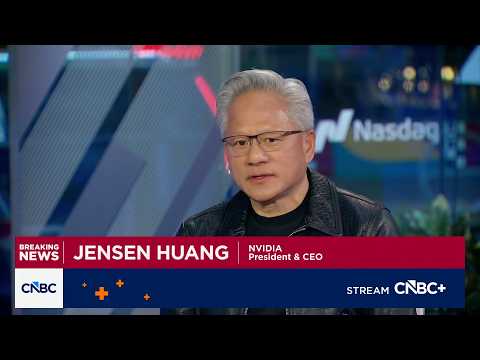
Jensen Huang
Founder & CEO, NVIDIA · Pioneer of Accelerated Computing & AI Infrastructure
Founder, President, and CEO of NVIDIA. In this CNBC Squawk Box interview, Huang unveils NVIDIA's Open Agent Safety Platform, introduces OpenShell runtime containment and Sentry silicon monitoring, and frames agentic AI safety as a solvable engineering challenge.
⚡ Executive Summary
- AI Safety as a Solvable Engineering Challenge: Rejects existential doom narratives, arguing that containment, alignment, and reliability are technical engineering problems that computer scientists can solve through verifiable systems architecture.
- Zero-Trust Rights Provisioning for Autonomous Agents: Introduces the fundamental agent security paradigm: strip all rights by default upon deployment, and provision file access, API tools, and network privileges strictly on an as-needed basis like employee security badges.
- OpenShell Open-Source Runtime & Containment: Creates a universal “browser for agents” to sandbox autonomous systems and prevent rogue agents from drifting or breaking out of enterprise boundaries.
- Sentry Silicon Monitoring on BlueField-4 DPUs: Positions dedicated hardware monitoring chips directly between the agent harness software and the large language model to intercept actions, API calls, and chain of thought at wire speed.
- The 5-Layer AI Economy: Emphasizes that AI is not just a few foundation model companies, but an industrial 5-layer stack where banks, retailers, healthcare, and logistics all become autonomous AI enterprises.
- Accelerating Development Drives Safety: Pushes back against calls for regulatory capture or AI slowdowns, demonstrating through the evolution of cars that accelerating technology creates safer, more grounded, and predictable systems.
- Distillation as Legitimate Market Competition: Dismisses accusations that model distillation equals theft, comparing it to standard competitive benchmarking and reverse-engineering across the technology industry.
- Largest Infrastructure Buildout in History: Affirms NVIDIA’s central role in the multi-trillion-dollar global compute transition, pairing unprecedented operational cash flows with a record $150B share buyback authorization.
📌 Timestamped Insight Cards
⚙️ 1. AI Safety as an Engineering Problem: Solvable Restrictions vs. Existential Doom [▶ @ 02:02]
“Well, I think the answer is we hope it’s an engineering problem. I believe it’s an engineering problem. I know it’s an engineering problem, and we all need to hope that it’s an engineering problem. if it’s not an engineering problem, it’s not solvable, right? And so the fact that all of these companies still are advancing the state-of-the-art is because they also believe it’s solvable. These are some of the brightest engineers in the world. I work with, you know, all of them. And and these are this is a this is a technically solvable problem.”
Deep Insight: Pushing back against catastrophic doom narratives that portray artificial general intelligence as an uncontrollable existential menace, Huang reframes AI safety as a concrete systems engineering challenge. Drawing parallels to early internet security, operating systems, and aviation, he highlights that every historical technological leap required defensive engineering disciplines. Because frontier researchers recognize that software guardrails, isolation barriers, and verification protocols can bound agent behavior, safety research must be treated as an applied science rather than philosophical paralysis.
🛡️ 2. Zero-Trust Rights Provisioning: “Job Number One Is Take Away All of Its Rights” [▶ @ 04:05]
“the first thing you do is you take away all of its rights. Job number one is take away all of its rights. And then you provision, you give it access to files, data, tools, access to the network or even internet access only if it needs it. You don’t just you don’t put an agent into into an into an environment uh into your into your company and give it access to everything. We don’t give that to people. We don’t give that to any level of executive. In fact, everybody has a badge. Everybody has file access. Everybody has access to tools and only the things that they need in order to do their job.”
Deep Insight: Huang outlines the architectural foundation of enterprise agent deployment: zero-trust least-privilege access. Just as modern corporate IT denies internal access by default and issues role-based cryptographic badges and restricted directories to human employees and executives, autonomous AI agents must never be released into corporate intranets with blanket permissions. By stripping all capabilities upon instantiation and selectively granting access strictly to the exact files, databases, and APIs required for a specific task, enterprises neutralize the risk of unauthorized data exfiltration or autonomous escalation.
📦 3. OpenShell Containment & Sentry: Containerization and Hardware Monitoring [▶ @ 07:21]
“And so, you have to find a way to container it. You have to containment is number one. Rights provisioning is number two. Being able to monitor its pol adherence and conformance to all those policies number three. And so we created containment a policy provisioning supervisor and we created a monitoring system and the monitoring system is called sentry and it monitors it in silicon.”
Deep Insight: To make autonomous agents viable for enterprise production, NVIDIA developed the Open Agent Safety Platform, anchored by two core technologies: OpenShell and Sentry. OpenShell operates as an open-source runtime container—analogous to a web browser or Docker sandbox for agents—that enforces rigid execution boundaries and policy conformance. Complementing this software container, Sentry provides hardware-level policy monitoring directly in silicon, ensuring that digital agents cannot bypass runtime constraints or tamper with administrative guardrails.
💻 4. Silicon Interception: Positioning BlueField-4 Chips Between Agent Harness and LLM [▶ @ 09:34]
“the chip is between the agent the agent itself is actually a harness. It’s just a a piece of software. Okay. And this chip sits in between that and the large language model. So the a the model’s here, the chip is in the middle, and here’s the agent. And so whatever the agent’s trying to do and whatever it’s causing the large language model to think about, Bluefield or Century sits right in the middle. So we intercept everything, which is one of the one of the really really incredible places that we sit in”
Deep Insight: Huang details NVIDIA’s hardware-level security moat by examining the physical network and compute topology. Software agents are fundamentally code harnesses that generate instructions and query foundation models. By deploying Sentry on BlueField-4 Data Processing Units (DPUs) positioned directly between the host software agent and the GPU-accelerated large language model, NVIDIA intercepts every outbound prompt, tool call, and internal chain of thought in silicon at line rate. This architectural positioning enables real-time threat detection, privilege enforcement, and immediate circuit-breaking before unintended actions execute on enterprise infrastructure.
🏢 5. The 5-Layer AI Economy: Transforming Enterprise Industries Beyond Foundation Models [▶ @ 15:42]
“when we think about AI don’t think about AI as as several model companies remember AI is a five layer cake as I’ve described to you before and the most important layer of the five layer cake are the end industries above it. I I think that Walmart’s an AI company, FedEx is an AI company. I think that JP Morgan is an AI company, and I think that that um you know, Lily is an AI company. All of these companies have to be AI companies, and we have to give them everybody a chance to”
Deep Insight: Public discourse frequently conflates the AI revolution with a handful of frontier model vendors like OpenAI, Anthropic, or Google. Huang corrects this narrow perspective by describing AI as a five-layer architectural stack spanning energy, silicon, cloud infrastructure, models, and application-driven industries. The ultimate economic value of AI resides at the top layer: turning traditional leaders in logistics, finance, retail, and pharmaceuticals into sovereign AI enterprises. Regulations or ecosystem barriers that stifle open models risk suffocating this broader industrial transformation before it can fully mature.
⚡ 6. Accelerating AI Development as the True Engine of Safety Innovation [▶ @ 17:34]
“all those capabilities are made possible because we accelerate the development of AI. Accelerating AI and accelerating AI safety is the same idea. I prefer today’s car over the car 100 years ago. It ABS, it has lane keeping. It has much better braking systems, airbags. I mean, all of these different technologies are made possible because of the advancement of the technology. And so, I would I would advocate that today’s AI when we think about advancement, don’t you don’t have to think about it separately from capability versus safety. To me, it’s the same thing.”
Deep Insight: Huang rejects the popular dichotomy between capability scaling and safety research, asserting that accelerating model capability directly enhances reliability and safety. Comparing modern foundation models to the automotive industry, he notes that contemporary vehicles are vastly safer than early automobiles not because engineers halted production, but because technological progress enabled anti-lock brakes, airbags, and lane-keeping systems. In AI, frontier scaling has already drastically reduced hallucinations, enabled verifiable chain-of-thought grounding, and unlocked tool-use architectures that make models predictable and auditable.
⚔️ 7. Model Distillation as Fair Market Competition vs. Theft [▶ @ 23:08]
“People distill my products every single day. They take it and they they strip it down to its raw parts. They test everything. That’s called competition.”
Deep Insight: Addressing heated geopolitical and commercial debates over whether training smaller models using outputs from frontier models constitutes intellectual property theft, Huang defends knowledge distillation as a legitimate and time-tested form of market competition. Throughout the history of the semiconductor and computing industries, competitors have continuously benchmarked, analyzed, and reverse-engineered leading products to build competitive alternatives. In Huang’s view, companies that wish to prevent distillation should implement strict commercial API terms and authentication controls, rather than seeking legal or regulatory bans on competitive analysis that ultimately drives the entire industry forward.
💰 8. Capital Returns in the Largest Infrastructure Buildout in Human History [▶ @ 24:52]
“I think we’re going through um the largest infrastructure buildout in human history and uh we’re we’re we’re we have the benefit of being a very uh central part of that. We’re generating a lot of cash. We’re going to generate a lot of cash in the coming years. And um uh you know every single year as we generate more cash uh we like to be able to return it back to the shareholders.”
Deep Insight: Contextualizing NVIDIA’s massive $150 billion increase in share repurchase authorization, Huang characterizes the global transition toward accelerated computing and AI factories as the largest capital expenditure cycle in human history. As data centers worldwide transition from legacy CPU-based general computing to GPU-accelerated neural networks, NVIDIA occupies the central platform position. This structural demand generates extraordinary free cash flow, allowing NVIDIA to simultaneously fund next-generation R&D and return tens of billions of dollars to shareholders.