Flo Crivello Interview Breakdown: Key Insights on Multiplayer Agents, Context Trees & Frontier Model Politics
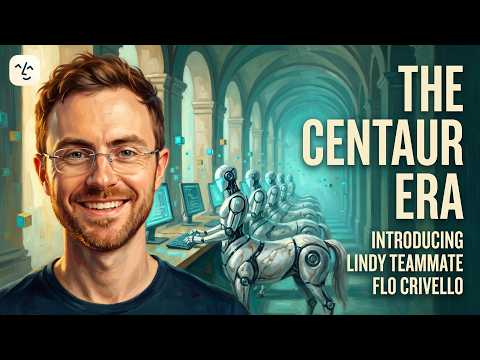
Flo Crivello
Founder & CEO, Lindy · Former Head of Product at Uber
Founder and CEO of Lindy, a pioneer in autonomous AI employees, and former Head of Product at Uber. In this in-depth conversation on The Cognitive Revolution, Crivello unveils Lindy Teammate and breaks down the technical mechanics of multiplayer agent architectures, sleep-state memory restructuring, the limits of the 'Centaur' model, and the uncomfortable game theory of using Chinese frontier models.
⚡ Executive Summary
- The Multiplayer AI Paradigm: Single-player 1:1 chat assistants are obsolete. High-leverage enterprise agents must live directly inside collaborative hubs like Slack as persistent, multiplayer teammates with shared organizational context.
- Context Primacy Over Model IQ: Raw model IQ is rapidly becoming a commoditized utility. An ordinary human coworker with full institutional context consistently outperforms an ungrounded superintelligence on real-world business tasks.
- Hierarchical Self-Balancing Memory (Context Trees): Naive summary chains create linear O(N) Russian doll bottlenecks. Lindy applies self-balancing tree structures (AVL/Red-Black principles) to maintain O(log N) retrieval across millions of tokens.
- The Sleep-State Memory Agent: Static vector search fails at scale. Lindy employs a dedicated background Memory Agent that reviews query logs during idle time (‘napping and dreaming’) to dynamically restructure topology and cache hot retrieval paths.
- The Fallacy of the Centaur Model: The ‘Human + AI beats pure AI’ thesis is a temporary transitional phase. As observed in superhuman games, human intervention eventually turns into negative alpha, injecting latency and noise into autonomous agent loops.
- The Chinese Model Game Theory & IP Tragedy: Startups face a severe coordination trap: adopting cheap, distilled Chinese open-weights models is mandatory for competitive survival, yet it economically undermines the multi-billion-dollar R&D investments required for Western frontier breakthroughs.
- Application Layer Squeeze: Frontier labs cross-subsidizing consumer subscriptions at rates far below raw token API costs creates extreme economic margin pressure on third-party application developers.
📌 Timestamped Insight Cards
👥 1. Multiplayer AI & The Google Docs Moment for Agents [▶ @ 04:46]
“I compare the difference between multiplayer and single player AI as between like sending each other weird documents and Google Docs like an actual shared document. If you really want your AI to be a teammate, your agent to be an actual member of the team, like you want it to be where your team collaborates, which is Slack, you want it to have its own shared context about the entire team, its own shared memory. You want everyone to be able to talk and collaborate with the same agent instead of right now it’s like we’re all in the same meeting room and we’re all talking and then every time one of us wants to talk to what’s turning out to be maybe the most important constituency of the company which is AI agents, we have to leave the room and then come back”
Deep Insight: Crivello identifies a fundamental architectural flaw in current enterprise AI deployments: single-player isolation. Operating isolated 1:1 chat windows is analogous to emailing disconnected Word files back and forth before Google Docs. To become an authentic coworker, an agent must live directly within the company’s shared communication fabric (e.g., Slack), actively observing real-time discussions, indexing cross-functional history, and maintaining unified team memory so all human employees collaborate with the same persistent intelligence.
🧠 2. Context Over Raw IQ: The John von Neumann Coworker Analogy [▶ @ 06:25]
“I really do think that as we we’re getting to AGI and as we now arguably have AGI, intelligence actually matters less and less comparatively speaking and context matters more and more. You know, I often think of it as like look, you know, like one of the smartest men in history was John Vonman, right? If you were to have John Vonoman just magically appear next to you at the office, this guy over the next hour or day would be less useful to you than your random coworker, right? So, and that’s because of context because you’re like, you got a job to do and like you don’t have time to onboard John, you know, he doesn’t have the context to it.”
Deep Insight: As foundation models approach frontier human intelligence, raw cognitive IQ becomes a commoditized baseline while organizational context emerges as the primary determinant of economic utility. Even a polymath of John von Neumann’s caliber cannot execute company tasks on day one without understanding internal acronyms, ongoing customer disputes, and codebase nuances. In business workflows, an ordinary human coworker with deep institutional context consistently outperforms an ungrounded superintelligence.
🌲 3. Self-Balancing Context Trees: Beyond Russian Doll Compaction [▶ @ 31:08]
“what I just described if you just do the nave implementation you get that really nice emerging property for free which is you have all of those linked context buckets that contain one another. But every context bucket always contains just one other context bucket. And so you end up with like this Russian doll of sorts of context buckets. And like if you if you want to open if you want to get to the bottom it takes a very long time if you want to you know. So what you do instead is that you have context packets contain multiple context packets. Okay? And and and and and so you end up with a tree because basically what you want is you want the topmost context bette not to contain the last 100. You want it to contain the first context bette and the last context bette.”
Deep Insight: Naively chaining summaries creates an O(N) linear linked-list (‘Russian doll’) where accessing historical context requires traversing every intermediary layer, causing latency spikes and severe degradation. Lindy solves this by structuring memory into self-balancing hierarchical trees (borrowing principles from AVL and Red-Black trees). The root node indexes macroscopic chronological anchor points, allowing the agent to perform O(log N) contextual lookups across hundreds of millions of historical tokens.
🤖 4. The Sleep-State Memory Agent & Dynamic Restructuring [▶ @ 42:03]
“I think one thing you may be leaving on the table is it is really healthy for all of the memory to be managed by one agent. even though that agent and and both retrieval and updating of the memory and so even though the memory is in a file system and so your agent could actually just go mess with the file system. What we have found actually and can still do that but we we tell the agent we prompt the agent to be like if you’re looking for memory that you don’t have please ask the memory agent and the reason why is because when we ask memory agents then what we do is that we log the query we log the answer and we log how many hops it took to retrieve that and then when the memory agent is napping and dreaming it looks at this log of like hey this is this is the kind of stuff people have been it’s also a librarian you know”
Deep Insight: Passive vector databases and naive RAG break down under dynamic enterprise workloads. Lindy introduces a dedicated ‘Memory Agent’ that acts as an active organizational librarian. When core working agents are idle, the Memory Agent runs asynchronous background maintenance (‘napping and dreaming’), analyzing retrieval query logs, calculating hop counts, and restructuring the underlying memory topology to pre-cache frequent query paths and prune stale information.
🦄 5. Deconstructing the Centaur Myth & Negative Human Alpha [▶ @ 01:04:24]
“And the reason I hate it is because it ladders into this myth of the the centur, you know, it’s like this mythical manhorse creature. And so, you know, it’s this idea that like yes, an AI is better than the human, but you know what’s even better than AI is AI plus human. Hence, humans are always going to be needed. And that’s a fantasy. That’s just not true. And the the literature is actually clear that this like you know we’ve seen it happen with chess and with every other game which which AI has achieved superhuman performance on where at first AI beats human and AI plus human beats just AI and little by little the gap of AI plus human versus AI is shrinking until it actually turns negative and humans are introducing at best like random noise into the system.”
Deep Insight: Crivello rejects the comforting narrative that ‘Human + AI’ will permanently outperform standalone AI systems. Drawing historical parallels from chess and complex games, he demonstrates that the ‘Centaur’ phase is merely a brief transition window. As models surpass human error thresholds, human intervention ceases to add complementary alpha and instead introduces latency, cognitive bias, and stochastic noise into highly optimized autonomous feedback loops.
🛡️ 6. Chinese Open-Weights & The Economic Free-Rider Dilemma [▶ @ 01:48:06]
“yes companies are training on all of these corpus that is available to everyone that is an an even playing field. The problem is that once you’ve done that at at great expense it does cost them billions of dollars. If you can if you can and you and you create that artifact out of this training data set which is called the model. Now other people can turn around and and instead of doing this which cost billions of dollars, they turn to this which costs a lot less than that and they copy you and they catch up with you. If you do that, you kill innovation. And that’s that’s it’s nothing new. It’s just called IP and patent law.”
Deep Insight: Despite Lindy utilizing open-weights Chinese models like DeepSeek for cost efficiency, Crivello candidly exposes the underlying economic tragedy of the commons. Frontier US labs spend tens of billions on high-risk base pre-training and reinforcement learning datasets. Distilling these frontier artifacts into open-weights models effectively free-rides on Western R&D—destroying the economic incentive to fund future $100B frontier training runs, analogous to generic pharma eliminating the R&D funding for original drug discovery.
⚡ 7. Application Layer Economics & Subsidized Inference [▶ @ 02:01:20]
“Yeah, it’s hard it’s hard to compete against tokens that are as heavily subsidized as as what Labs are doing. That’s that’s just the reality of the application layer right now. Anything else you want to say or touch on before we break for today? This has been great. Well, I’d be I’d be remiss if I didn’t mention, you know, obviously we all releasing Lind.ai like Lindimate. It’s on Lindy.ai. I I I think be ready to see more, not just from us, but I do believe the next six months are going to be about multiplayer AI and about this like Iron Man suit, like about this human AI hybrid and these products that create this human AI hybrid organization.”
Deep Insight: Frontier AI laboratories engage in aggressive cross-subsidization, offering unlimited model access via consumer subscriptions (like ChatGPT Pro or Claude Max) at effective unit economics that severely undercut raw API token pricing. This dynamics places severe economic pressure on third-party application builders, necessitating radical efficiency gains via open-weights distillation, intelligent model tiering, and deep proprietary organizational workflow capture.