Garry Tan Interview Breakdown: Key Insights on Personal AGI, Skill Files & the 400x Founder
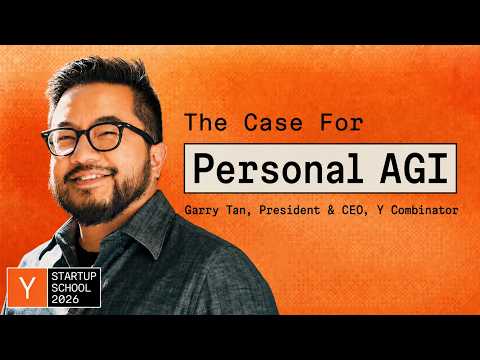
Garry Tan
President & CEO, Y Combinator · Founder, Initialized Capital · Early Co-Founder, Posterous
President & CEO of Y Combinator and founder of Initialized Capital. In this landmark Startup School 2026 keynote, Tan presents the technical and philosophical blueprint for 'Personal AGI'—demonstrating how compounding markdown knowledge graphs, autonomous agent skill files, and sovereign cognitive ownership give individual founders 400x leverage.
⚡ Executive Summary
- The Personal AGI Paradigm: AGI is not arriving as a single god in a centralized cloud datacenter, but diffused as personal agents running on private infrastructure, executing custom procedures over sovereign markdown context.
- 400x Founder Multiplier: The fastest-growing YC founders no longer treat AI as autocomplete, but as an autonomous markdown-driven workforce—scaling software and operations with unprecedented revenue-per-employee ratios.
- Overcoming the 7-Item Memory Limit: Human working memory is biologically capped at 7 items (±2), whereas modern LLMs process 1M tokens. The competitive moat lies entirely in curated retrieval—ensuring the “right three books” are opened at the right step.
- English as the Universal Programming Language: High-level Markdown is now compiled by frontier models into executable code, separating latent space reasoning (taste, intent) from deterministic computation (SQL, math).
- The “Skillify” Compounding Flywheel: One-off prompting is dead. Every solved operational task must be distilled into a reusable markdown skill file, transforming ephemeral interactions into permanent institutional assets.
- The Politics of Cognitive Extraction: When skill files live in a corporate repository, worker judgment is permanently extracted; when owned in a personal repository, judgment compounds into a sovereign career moat.
- The Collapse of Startup Difficulty: Historical barriers—funding, credentials, massive teams—were mere workarounds for individual working memory limits. With a laptop and personal library, a solo founder can tackle what once required an entire enterprise.
📌 Timestamped Insight Cards
🤖 1. Personal AGI vs. Corporate Rented Intelligence [▶ @ 07:01]
“Personal AGI is a different animal. An agent that runs on your infrastructure, reads from a memory you own, executes procedures you wrote, and compounds. The corporate AGI you don’t own gets better only when the company ships something. Your personal AGI gets better every single day you use it because every day it knows more of your life. One of these is a product you consume. The other is an asset you build.”
Deep Insight: Tan draws a sharp architectural and economic line between commodity AI chatbots and true ‘Personal AGI.’ Rented commercial assistants provide ephemeral value that resets upon tab closure and remains constrained by vendor roadmaps. In contrast, Personal AGI represents a private, sovereign system operating on user-controlled infrastructure, continuously ingesting personal context, and executing user-authored skill procedures to compound in enterprise value over time.
⚡ 2. The 400x Founder Multiplier & AI as a Workforce [▶ @ 09:56]
“The fastest growing founders we fund are not treating AI as autocomplete. They are treating it as a workforce. There are 2X people and there are 100X people who are using the same cloud, same weights, same context window size, same API, but the leverage is not in the weights. It’s in what context you give it, how relevant it is, and does it happen at the right step.”
Deep Insight: Frontier foundation models are an increasingly commoditized utility accessible to everyone at equal cost. The differentiator between 2x and 100x leverage is not the raw intelligence of the model weights, but the architectural harness and curated context surrounding it. Founders who treat agents as an autonomous markdown workforce achieve staggering revenue-per-employee metrics (60M ARR with 40 people) that shatter historical software economics.
🧠 3. Escaping Human Working Memory Limits [▶ @ 12:48]
“You and I, as human beings, hold about seven things in our head at once. Seven plus or minus two. It’s the most famous paper in cognitive psychology. It’s why local phone numbers are seven digits, and why you forget the eighth item on a grocery list. That is the entire working memory of a human being.”
Deep Insight: Traditional organizations, management layers, and communication overhead are essentially historical prosthetics designed to compensate for the biological limit of human working memory (Miller’s Law: 7 ± 2 items). AI agents operating with 1-million-token context windows (the equivalent of three full books) break this constraint. The primary engineering challenge shifts from information retention to context arbitration: deciding precisely which files and memories should be loaded into active working memory at any given second.
💻 4. Markdown Is Code: Latent vs. Deterministic Space [▶ @ 17:47]
“Markdown is actually code. If you can write clear instructions in English, you’re a programmer. The compiler is a language model. And that’s why it’s not just for engineers anymore. At YC, our media people, event staff, finance team, people who never open a terminal in their lives, are building skill files and schedule jobs.”
Deep Insight: Plain-English Markdown files act as executable programs compiled by LLMs, turning non-technical operators into agent managers. Crucially, robust agent architectures must strictly separate latent space (taste, judgment, high-level intent interpretation) from deterministic space (SQL queries, discrete arithmetic, rigid scheduling). Agentic systems fail when models attempt deterministic math in latent space; the optimal pattern is markdown instructions invoking deterministic databases and scripts.
🔄 5. The ‘Skillify’ Protocol: Eliminating One-Off Work [▶ @ 27:17]
“Never do one-off work. Most people run one operation with one agent and then throw the context away. They close the window, that’s it. Don’t. At the end of every task, ask the agent to skillify what it did.”
Deep Insight: The core discipline distinguishing high-leverage builders from dabblers is the systematic elimination of ephemeral tasks. Whenever an agent successfully solves a novel problem or automates a workflow, the user must invoke a ‘skillify’ step to distill the exact procedure, edge cases, and rules into a permanent, version-controlled markdown skill. This converts daily operational friction into an ever-expanding, reusable organizational asset.
🛡️ 6. The Politics of Skill Files & Cognitive Ownership [▶ @ 30:59]
“Own your skills because if you don’t, your job becomes a skill file. And this happened before. Craftsmen own their tools. That’s what made them free. The factory broke that. The loom belonged to the mill. The knowledge workers assumed we were safe because our tools lived in our heads where nobody could confiscate them. Skill files end that. For the first time in history, your cognition can be extracted, stored, versioned and owned.”
Deep Insight: Historically, knowledge workers maintained career security because their specialized judgment remained locked in their biology. Skill files externalize human cognition into executable code. If those skill files reside in a corporate repository, the employee’s judgment is permanently extracted and operationalized without them. Tan urges knowledge workers and founders to retain custody of their own skill repositories and private knowledge graphs to safeguard their economic sovereignty.
🚀 7. The Collapse of Startup Difficulty [▶ @ 39:01]
“A father, a laptop, and a library. That is personal AGI. Not a benchmark, not a demo. The entire architecture I’ve described tonight, the library, the librarian, the right three books open at the right moment, aimed at the one thing one man loves the most in the world. Nobody was coming to build that for him. So he built it. And nobody is coming to build yours for you.”
Deep Insight: Reflecting on Spinoza’s maxim that ‘all things excellent are as difficult as they are rare,’ Tan asserts that modern agentic tooling has collapsed the barrier of difficulty. Achieving monumental feats—whether researching rare medical conditions across 80,000 papers or building nine-figure enterprise startups—no longer requires institutional permission, large teams, or massive venture funding. The leverage is democratized; the rarity is now defined purely by individual striving and execution.