Jensen Huang Interview Breakdown: Key Insights on xAI Colossus, Physical AI & 1,000x Scaling
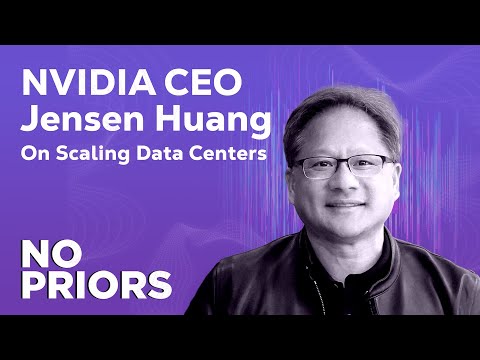
Jensen Huang
Founder & CEO, NVIDIA
Leading NVIDIA's next computing paradigm from digital tokens to Physical AI. In this deep dive, Huang breaks down xAI's record-setting 100k GPU Colossus deployment in 19 days, why general-purpose computing is obsolete, and how AI-designed semiconductors are sustaining 1,000x multi-decade speedups.
⚡ Executive Summary
- Hyper Moore’s Law Compounding: NVIDIA is scaling computing performance by 2x-3x every year at datacenter cluster scale—driving down costs and energy consumption by 2x-3x annually into an aggressive compounding curve.
- The Million-X Marginal Cost Revolution: Collapsing computing costs by a factor of 1,000,000x over the last decade unlocked the fundamental shift from human-engineered software to computers writing software directly from data.
- The Datacenter As A Compute Fabric: NVLink and InfiniBand treat the entire network as a unified processor, enabling high-bandwidth, sub-millisecond inter-GPU communication essential for test-time reasoning models.
- The 19-Day xAI Colossus Deployment: Standing up a 100,000 H100 liquid-cooled supercluster in a few weeks was made possible by pre-simulating network configs and physical supply chains as Omniverse digital twins.
- AI Recursion in Chip Design: Hopper and Blackwell GPUs contain tens of billions of transistors; human engineers lack the combinatorial bandwidth to optimize floorplans, making AI reinforcement learning agents essential to designing chips.
- Tokens are Tokens in Physical AI: Robotic manipulation shares the same underlying tokenization architecture as LLMs; autonomous driving and humanoid robots represent the two scalable “Brownfield” platforms suited for existing human infrastructure.
- Enterprise SaaS as Agentic Goldmines: Specialized enterprise platforms (Salesforce, SAP, ServiceNow) will not be disrupted; they sit on proprietary domain goldmines that will host millions of specialized, collaborative AI coworkers.
📌 Timestamped Insight Cards
⚡ 1. Hyper Moore’s Law: Doubling Datacenter Performance Annually [▶ @ 01:43]
“Over the next 10 years, our hope is that we could double or triple performance every year at scale—not at chip, at scale—and to be able to therefore drive the cost down by a factor of two or three, drive the energy down by a factor of two or three every single year. When you double or triple every year, in just a few years it adds up, so it compounds really, really aggressively. I wouldn’t be surprised if we’re going to be on some kind of a hyper Moore’s Law curve.”
Deep Insight: Classical Moore’s Law targeted transistor doubling on single silicon dies. NVIDIA has redefined scaling to the datacenter cluster level—co-designing liquid cooling, interconnect fabrics, and micro-architectures to double or triple system-level throughput per watt annually, driving an aggressive compounding curve.
💰 2. The Million-X Cost Reduction: Letting Computers Write Software [▶ @ 23:42]
“That’s how big of a deal it is that we’ve driven down the marginal cost of computing down probably by a million x in the last 10 years to the point that we say, ‘Hey, let’s just let the computer go exhaustively write the software.’ That’s the big realization… We would love for the computer to go discover something about our chips that we otherwise couldn’t have done ourselves—explore our chips and optimize it in a way that we couldn’t do ourselves.”
Deep Insight: The deep learning revolution is fundamentally an economic phenomenon: collapsing computing costs by six orders of magnitude made brute-force statistical learning viable. When computing becomes virtually free, human hand-engineering gives way to computers discovering and optimizing complex software, chip layouts, and scientific models autonomously.
🌐 3. The Datacenter Is the New Unit of Compute: NVLink as the Virtual Superchip [▶ @ 03:41]
“The second part of it is data center scale. Unless you could treat the network as a compute fabric and push a lot of the work into the network, push a lot of the work into the fabric and as a result you’re compressing at very large scales… That’s the reason why we bought Mellanox and started fusing InfiniBand and NVLink in such an aggressive way.”
Deep Insight: Modern test-time reasoning and massive context windows require breaking physical chip boundaries. NVLink and InfiniBand networking dissolve latency barriers, transforming thousands of discrete GPUs into a single virtual processor with massive collective memory bandwidth.
🚀 4. xAI Colossus Logistics: 100,000 H100s Brought Online in Weeks [▶ @ 15:06]
“A lot of that credit you got to give to Elon. First of all, to decide to do something, select the site, bring cooling to it, power, and then decide to build this 100,000 GPU supercluster which is the largest of its kind in one unit… We simulated all the network configurations, we pre-staged everything as a digital twin… and within a few weeks, the clusters were up.”
Deep Insight: Bringing up the world’s largest unified AI supercomputer (xAI’s Colossus) in 19 days was a masterclass in industrial digital twin engineering. NVIDIA and xAI simulated every fiber cable route, liquid-cooling distribution manifold, and InfiniBand switch in software before physical hardware arrived on-site, eliminating integration bottlenecks during installation.
🔬 5. Recursive AI in Chip Design: Designing Next-Gen GPUs with AI [▶ @ 21:07]
“We have AI chip designers here at NVIDIA… How effective are AI chip designers today? Super good. We couldn’t build Hopper without it. And the reason for that is because they could explore a much larger space than we can, and because they have infinite time—they’re running on a supercomputer. We have so little time using human engineers that we don’t explore as much of the space as we should.”
Deep Insight: Semiconductor engineering has crossed into recursive self-improvement. With modern chips packing over 100 billion transistors, the combinatorial design space for floorplanning, power distribution networks, and timing closure exceeds human cognitive limits. NVIDIA employs reinforcement learning agents to discover layout optimizations that human engineers could never formulate.
🤖 6. Physical AI & General Robotics: Tokenizing the Embodied World [▶ @ 27:10]
“We’re close to artificial general intelligence, but we’re also close to artificial general robotics. Tokens are tokens. The question is: can you tokenize it?… If I can generate a video that has Jensen reaching out to pick up the coffee cup, why can’t I prompt a robot to generate the tokens that’ll pick up the cup?… Between self-driving cars with digital chauffeurs and embodied robots, we could literally bring robotics to the world without changing the world, because we built the world for those two things.”
Deep Insight: The algorithmic principles underpinning language models translate directly to robotics: motor control actions are physical tokens generated conditioned on multimodal sensory inputs. Because human infrastructure was physically constructed around automobiles and human bodies, autonomous vehicles and humanoid robots represent the two scalable “Brownfield” robotic platforms capable of immediate deployment.
🏢 7. The 100M AI Agent Economy: Software Platforms Sitting on Agentic Goldmines [▶ @ 30:34]
“People say that these SaaS platforms are going to be disrupted. I actually think the opposite: that they’re sitting on a gold mine, that they’re going to be this flourishing of agents that are going to be specialized in Salesforce, specialized in SAP… And who’s going to create an AI agent that’s awesome at OpenUSD? We are, because nobody cares about them more than we do. These platforms are going to be flourishing with agents, and we’re going to introduce them to each other and they’re going to collaborate to solve problems.”
Deep Insight: Enterprise software incumbents will not be destroyed by foundation models; rather, their specialized domain schemas and proprietary data systems make them prime operating grounds for AI workers. Future organizations will hire and rent millions of specialized AI agents (e.g., AI chip layout specialists or automated financial auditors) that navigate enterprise SaaS systems to solve complex cross-departmental missions.